Nature
Dogma
Ritual
Enochian
Lemegeton
Thelema
Solve et Coagula
The Four Elements |
||||||||||||||||||||||||||||||||||||||||||||||||||||||||||||||||||||||||||||||||||||||||||||||||||||||||||||||||||||||||||||||||||||||||||||||||||||||||||||||||||||||
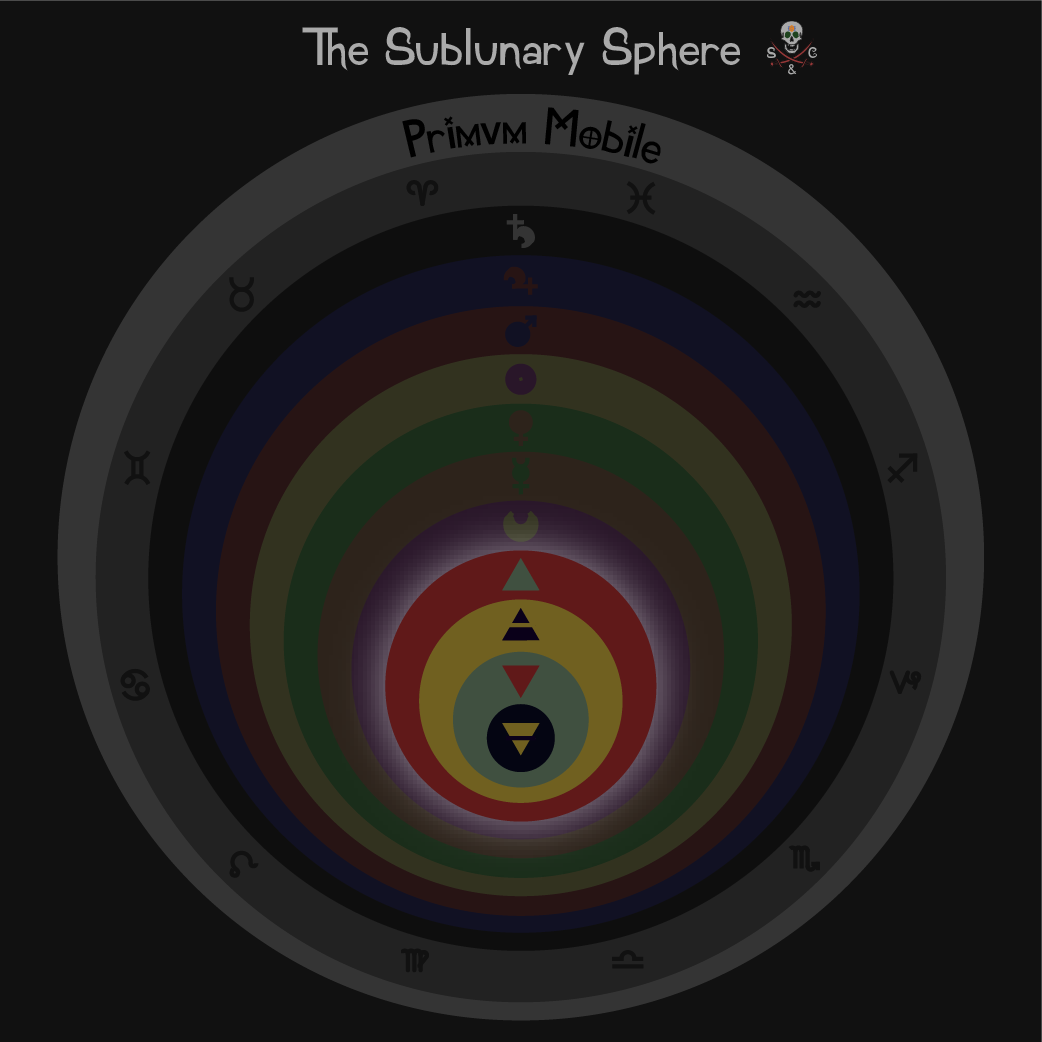
"'But tell me,' said I, 'whence did the elements of nature come into being?' He answered, 'They issued from God's
Purpose, which beheld that beauteous world and copied it. The watery substance, having received the Word, was fashioned
into an ordered world, the elements being separated out from it; and from the elements came forth the brood of living
creatures. Fire unmixed leapt forth from the watery substance, and rose up aloft; the fire was light and keen, and active. And therewith
the air too, being light, followed the fire, and mounted up till it reached the fire, parting from earth and water; so that it seemed that
the air was suspended from the fire. And the fire was encompassed by a mighty power, and was held fast, and stood firm.
But earth and water remained in their own place, mingled together, so as not to be distinguished; but they were kept in
motion, by reason of the breath-like Word which moved upon the face of the water.
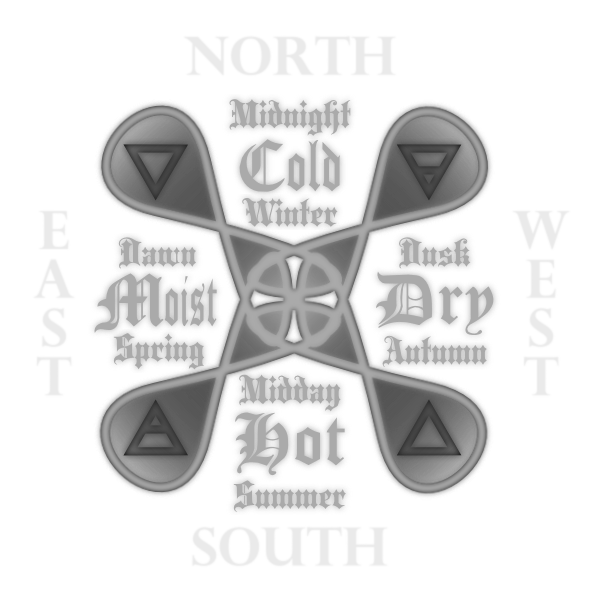
Remarking on the elements and their qualities, Aristotle says in On Generation and Corruption, Book II: part 3,
"The elementary qualities are four, and any four terms can be combined in six couples. Contraries, however, refuse to be
coupled: for it is impossible for the same thing to be hot and cold, or moist and dry. Hence it is evident that the
'couplings' of the elementary qualities will be four: hot with dry and moist with hot, and again cold with dry and cold
with moist. And these four couples have attached themselves to the apparently 'simple' bodies (Fire, Air, Water, and
Earth) in a manner consonant with theory. For Fire is hot and dry, whereas Air is hot and moist (Air being a sort of
aqueous vapour); and Water is cold and moist, while Earth is cold and dry. Thus the differences are reasonably
distributed among the primary bodies, and the number of the latter is consonant with theory. For all who make the
simple bodies 'elements' postulate either one, or two, or three, or four. Now (i) those who assert there is one only,
and then generate everything else by condensation and rarefaction, are in effect making their 'originative sources'
two, viz. the rare and the dense, or rather the hot and the cold: for it is these which are the moulding forces, while
the 'one' underlies them as a 'matter'. But (ii) those who postulate two from the start-as Parmenides postulated Fire
and Earth-make the intermediates (e.g. Air and Water) blends of these. The same course is followed (iii) by those who
advocate three. (We may compare what Plato does in Me Divisions': for he makes 'the middle' a blend.) Indeed, there is
practically no difference between those who postulate two and those who postulate three, except that the former split
the middle 'element' into two, while the latter treat it as only one. But (iv) some advocate four from the start, e.g.
Empedocles: yet he too draws them together so as to reduce them to the two, for he opposes all the others to Fire. |
||||||||||||||||||||||||||||||||||||||||||||||||||||||||||||||||||||||||||||||||||||||||||||||||||||||||||||||||||||||||||||||||||||||||||||||||||||||||||||||||||||||
Plato [429–347 BC] |
||||||||||||||||||||||||||||||||||||||||||||||||||||||||||||||||||||||||||||||||||||||||||||||||||||||||||||||||||||||||||||||||||||||||||||||||||||||||||||||||||||||
Timaeus, Plato; Written 360 B.C.E; Translated by Benjamin JowettTimaeus speaking to Socrates:"Now that which is created is of necessity corporeal, and also visible and tangible. And nothing is visible where there is no fire, or tangible which has no solidity, and nothing is solid without earth. Wherefore also God in the beginning of creation made the body of the universe to consist of fire and earth. But two things cannot be rightly put together without a third; there must be some bond of union between them. And the fairest bond is that which makes the most complete fusion of itself and the things which it combines; and proportion is best adapted to effect such a union. For whenever in any three numbers, whether cube or square, there is a mean, which is to the last term what the first term is to it; and again, when the mean is to the first term as the last term is to the mean-then the mean becoming first and last, and the first and last both becoming means, they will all of them of necessity come to be the same, and having become the same with one another will be all one. If the universal frame had been created a surface only and having no depth, a single mean would have sufficed to bind together itself and the other terms; but now, as the world must be solid, and solid bodies are always compacted not by one mean but by two, God placed water and air in the mean between fire and earth, and made them to have the same proportion so far as was possible (as fire is to air so is air to water, and as air is to water so is water to earth); and thus he bound and put together a visible and tangible heaven. And for these reasons, and out of such elements which are in number four, the body of the world was created, and it was harmonised by proportion, and therefore has the spirit of friendship; and having been reconciled to itself, it was indissoluble by the hand of any other than the framer." "In the first place, we see that what we just now called water, by condensation, I suppose, becomes stone and earth; and this same element, when melted and dispersed, passes into vapour and air. Air, again, when inflamed, becomes fire; and again fire, when condensed and extinguished, passes once more into the form of air; and once more, air, when collected and condensed, produces cloud and mist; and from these, when still more compressed, comes flowing water, and from water comes earth and stones once more; and thus generation appears to be transmitted from one to the other in a circle. Thus, then, as the several elements never present themselves in the same form, how can any one have the assurance to assert positively that any of them, whatever it may be, is one thing rather than another? No one can. But much the safest plan is to speak of them as follows:-Anything which we see to be continually changing, as, for example, fire, we must not call 'this' or 'that', but rather say that it is 'of such a nature'; nor let us speak of water as 'this'; but always as 'such'; nor must we imply that there is any stability in any of those things which we indicate by the use of the words 'this' and 'that', supposing ourselves to signify something thereby; for they are too volatile to be detained in any such expressions as 'this', or 'that', or 'relative to this', or any other mode of speaking which represents them as permanent. We ought not to apply 'this' to any of them, but rather the word 'such'; which expresses the similar principle circulating in each and all of them; for example, that should be called 'fire' which is of such a nature always, and so of everything that has generation. [...] And the same argument applies to the universal nature which receives all bodies-that must be always called the same; for, while receiving all things, she never departs at all from her own nature, and never in any way, or at any time, assumes a form like that of any of the things which enter into her; she is the natural recipient of all impressions, and is stirred and informed by them, and appears different from time to time by reason of them. But the forms which enter into and go out of her are the likenesses of real existences modelled after their patterns in wonderful and inexplicable manner, which we will hereafter investigate. For the present we have only to conceive of three natures: first, that which is in process of generation; secondly, that in which the generation takes place; and thirdly, that of which the thing generated is a resemblance. And we may liken the receiving principle to a mother, and the source or spring to a father, and the intermediate nature to a child; and may remark further, that if the model is to take every variety of form, then the matter in which the model is fashioned will not be duly prepared, unless it is formless, and free from the impress of any of these shapes which it is hereafter to receive from without. For if the matter were like any of the supervening forms, then whenever any opposite or entirely different nature was stamped upon its surface, it would take the impression badly, because it would intrude its own shape. Wherefore, that which is to receive all forms should have no form; as in making perfumes they first contrive that the liquid substance which is to receive the scent shall be as inodorous as possible; or as those who wish to impress figures on soft substances do not allow any previous impression to remain, but begin by making the surface as even and smooth as possible. In the same way that which is to receive perpetually and through its whole extent the resemblances of all eternal beings ought to be devoid of any particular form. Wherefore, the mother and receptacle of all created and visible and in any way sensible things, is not to be termed earth, or air, or fire, or water, or any of their compounds or any of the elements from which these are derived, but is an invisible and formless being which receives all things and in some mysterious way partakes of the intelligible, and is most incomprehensible. In saying this we shall not be far wrong ; as far, however, as we can attain to a knowledge of her from the previous considerations, we may truly say that fire is that part of her nature which from time to time is inflamed, and water that which is moistened, and that the mother substance becomes earth and air, in so far as she receives the impressions of them." "To earth, then, let us assign the cubical form ; for earth is the most immoveable of the four and the most plastic of
all bodies, and that which has the most stable bases must of necessity be of such a nature. Now, of the triangles which
we assumed at first, that which has two equal sides is by nature more firmly based than that which has unequal sides ;
and of the compound figures which are formed out of either, the plane equilateral quadrangle has necessarily, a more
stable basis than the equilateral triangle, both in the whole and in the parts. Wherefore, in assigning this figure to
earth, we adhere to probability ; and to water we assign that one of the remaining forms which is the least moveable ;
and the most moveable of them to fire ; and to air that which is intermediate. Also we assign the smallest body to fire,
and the greatest to water, and the intermediate in size to air ; and, again, the acutest body to fire, and the next in
acuteness to, air, and the third to water. Of all these elements, that which has the fewest bases must necessarily be
the most moveable, for it must be the acutest and most penetrating in every way, and also the lightest as being composed
of the smallest number of similar particles : and the second body has similar properties in a second degree, and the
third body in the third degree. Let it be agreed, then, both according to strict reason and according to probability,
that the pyramid is the solid which is the original element and seed of fire ; and let us assign the element which was
next in the order of generation to air, and the third to water. We must imagine all these to be so small that no
single particle of any of the four kinds is seen by us on account of their smallness : but when many of them are
collected together their aggregates are seen. And the ratios of their numbers, motions, and other properties, everywhere
God, as far as necessity allowed or gave consent, has exactly perfected, and harmonised in due proportion. "In the next place we have to consider that there are divers kinds of fire. There are, for example, first, flame; and
secondly, those emanations of flame which do not burn but only give light to the eyes; thirdly, the remains of fire,
which are seen in red-hot embers after the flame has been extinguished. There are similar differences in the air; of
which the brightest part is called the aether, and the most turbid sort mist and darkness; and there are various other
nameless kinds which arise from the inequality of the triangles. Water, again, admits in the first place of a division
into two kinds; the one liquid and the other fusile. The liquid kind is composed of the small and unequal particles of
water; and moves itself and is moved by other bodies owing to the want of uniformity and the shape of its particles ;
whereas the fusile kind, being formed of large and uniform particles, is more stable than the other, and is heavy and
compact by reason of its uniformity. But when fire gets in and dissolves the particles and destroys the uniformity, it
has greater mobility, and becoming fluid is thrust forth by the neighbouring air and spreads upon the earth; and this
dissolution of the solid masses is called melting, and their spreading out upon the earth flowing. Again, when the fire
goes out of the fusile substance, it does not pass into vacuum, but into the neighbouring air ; and the air which is
displaced forces together the liquid and still moveable mass into the place which was occupied by the fire, and unites
it with itself. Thus compressed the mass resumes its equability, and is again at unity with itself, because the fire
which was the author of the inequality has retreated; and this departure of the fire is called cooling, and the coming
together which follows upon it is termed congealment. Of all the kinds termed fusile, that which is the densest and is
formed out of the finest and most uniform parts is that most precious possession called gold, which is hardened by
filtration through rock; this is unique in kind, and has both a glittering and a yellow colour. A shoot of gold, which
is so dense as to be very hard, and takes a black colour, is termed adamant. There is also another kind which has parts
nearly like gold, and of which there are several species; it is denser than gold, and it contains a small and fine
portion of earth, and is therefore harder, yet also lighter because of the great interstices which it has within itself;
and this substance, which is one of the bright and denser kinds of water, when solidified is called copper. There is an
alloy of earth mingled with it, which, when the two parts grow old and are disunited, shows itself separately and is
called rust. The remaining phenomena of the same kind there will be no difficulty in reasoning out by the method of
probabilities. A man may sometimes set aside meditations about eternal things, and for recreation turn to consider the
truths of generation which are probable only; he will thus gain a pleasure not to be repented of, and secure for himself
while he lives a wise and moderate pastime. Let us grant ourselves this indulgence, and go through the probabilities
relating to the same subjects which follow next in order. |
||||||||||||||||||||||||||||||||||||||||||||||||||||||||||||||||||||||||||||||||||||||||||||||||||||||||||||||||||||||||||||||||||||||||||||||||||||||||||||||||||||||
Heinrich Cornelius Agrippa (1486-1535) |
||||||||||||||||||||||||||||||||||||||||||||||||||||||||||||||||||||||||||||||||||||||||||||||||||||||||||||||||||||||||||||||||||||||||||||||||||||||||||||||||||||||
De Occulta PhilosophiaBook One: Natural MagicChap. iii. Of the four Elements, their qualities, and mutual mixtionsThere are four Elements, and original grounds of all corporeal things, Fire, Earth, Water, Air, of which all elementated inferiour bodies are compounded; not by way of heaping them up together, but by transmutation, and union; and when they are destroyed, they are resolved into Elements. For there is none of the sensible Elements that is pure, but they are more or less mixed, and apt to be changed one into the other: Even as Earth becoming dirty, and being dissolved, becomes Water, and the same being made thick and hard, becometh Earth again; but being evaporated through heat, passeth into Air, and that being kindled, passeth into Fire, and this being extinguished, returns back again into Air, but being cooled again after its burning, becometh Earth, or Stone, or Sulphur, and this is manifested by Lightening. Plato also was of that opinion, that Earth was wholly changeable, and that the rest of the Elements are changed, as into this, so into one another successively. But it is the opinion of the subtiller sort of Philosophers, that Earth is not changed, but relented and mixed with other Elements, which do dissolve it, and that it returns back into it self again. Now, every one of the Elements hath two specifical qualities, the former whereof it retains as proper to it self, in the other, as a mean, it agrees with that which comes next after it. For Fire is hot and dry, the Earth dry and cold, the Water cold and moist, the Air moist and hot. And so after this manner the Elements, according to two contrary qualities, are contrary one to the other, as Fire to Water, and Earth to Air. Moreover, the Elements are upon another account opposite one to the other: For some are heavy, as Earth and Water, and others are light, as Air and Fire. Wherefore the Stoicks called the former passives, but the latter actives. And yet once again Plato distinguished them after another manner, and assigns to every one of them three qualities, viz. to the Fire brightness, thinness and motion, but to the Earth darkness, thickness and quietness. And according to these qualities the Elements of Fire and Earth are contrary. But the other Elements borrow their qualities from these, so that the Aire receives two qualities of the Fire, thinness and motion; and one of the Earth, viz. darkness. In like manner Water receives two qualities of the Earth, darkness and thickness, and one of Fire, viz. motion. But Fire is twice more thin then Air, thrice more movable, and four times more bright: and the Air is twice more bright, thrice more thin, and four times more moveable then Water. Wherefore Water is twice more bright then Earth, thrice more thin, and four times more movable. As therefore the Fire is to the Air, so Air is to the Water, and Water to the Earth; and again, as the Earth is to the Water, so is the Water to the Air, and the Air to the Fire. And this is the root and foundation of all bodies, natures, virtues, and wonderfull works; and he which shall know these qualities of the Elements, and their mixtions, shall easily bring to pass such things that are wonderful, and astonishing, and shall be perfect in Magick. Chap. vii. Of the kinds of compounds, what relation they stand in to the elements, and what relation there is betwixt the elements themselves, and the soul, senses, and dispoisitions of men.Next after the four simple Elements follow the four kinds of perfect Bodies compounded of them, and they are Stones, Metals, Plants, and Animals: and although unto the generation of each of these all the Elements meet together in the composition, yet every one of them follows, and resembles one of the Elements, which is most predominant. For all Stones are earthy, for they are naturally heavy, and descend, and so hardened with dryness, that they cannot be melted. But Metals are waterish, and may be melted, which Naturalists confess, and chemists finde to be true, viz. that they are generated of a viscous Water, or waterish argent vive. Plants have such an affinity with the Aire, that unless they be abroad in the open Aire, they do neither bud, nor increase. So also all animals: Have in their natures a most fiery force,And Fire is so naturall to them, that that being extinguished they presently die. And again every one of those kinds is distinguished within it self by reason of degrees of the Elements. For amongst the Stones they especially are called earthy that are dark, and more heavy; and those waterish, which are transparent, and are compacted of water, as crystal, beryl, and pearls in the shells of Fishes: and they are called airy, which swim upon the Water, and are spongious, as the Stones of a Sponge, the pumice Stone, and the Stone Sophus: and they are called fiery, out of which fire is extracted, or which are resolved into Fire, or which are produced of Fire: as Thunderbolts, Fire-stones, and the stone asbestos. Also amongst Metals, Lead, and Silver are earthy; Quicksilver is waterish: Copper, and Tin are airy: and Gold, and Iron are fiery.
In plants also, the roots resemble the Earth, by reason of their thickness: and the leaves, Water, because of their juice: Flowers, the Aire, because of their subtility, and the Seeds the Fire, by reason of their multiplying spirit. Besides, they are called some hot, wine cold, sonic moist, some dry, borrowing their names from the qualifies of the Elements.
Amongst animals also, some are in comparison of others earthy, and dwell in the bowels of the Earth, as worms and moles, and many other small creeping vermin; others are watery, as fishes; others airy, which cannot live out of the air: others also are fiery, living in the fire, as salamanders, and crickets, such as are of a fiery heat, as pigeons, ostriches, lions, and such as the wise man cals beasts breathing Fire. Besides, in animals the bones resemble the Earth, flesh the Air, the vital spirit the Fire, and the humors the Water. And these humors also partake of the Elements, for yellow choler is instead of Fire, blood instead of Air, phlegm instead of Water, and black choler, or melancholy instead of Earth. And lastly, in the Soul it self, according to Austin, the understanding resembles Fire, reason the Air, imagination the Water, and the senses the Earth. And these senses also are divided amongst themselves by reason of the Elements, for the sight is fiery, neither can it perceive without Fire, and Light: the hearing is airy, for a sound is made by the striking of the Air; The smell, and taste resemble the Water, without the moisture of which there is neither smell, nor taste; and lastly the feeling is wholly earthy, and taketh gross bodies for its object. The actions also, and the operations of man are governed by the Elements. The Earth signifies a slow, and firm motion; The water signifies fearfulness, & sluggishness, and remisseness in working: Aire signifies cheerfulness, and an amiable disposition: but Fire a fierce, quick and angry disposition. The Elements therefore are the first of all things, and all things are of, and according to them, and they are in all things, and diffuse their vertues through all things. Book Two: Celestial MagicChapter vii. Of the Number of Four, and the Scale thereofThe Scale of the Number four, answering the four Elements
|
||||||||||||||||||||||||||||||||||||||||||||||||||||||||||||||||||||||||||||||||||||||||||||||||||||||||||||||||||||||||||||||||||||||||||||||||||||||||||||||||||||||
Eliphas Levi (1810-1875) |
||||||||||||||||||||||||||||||||||||||||||||||||||||||||||||||||||||||||||||||||||||||||||||||||||||||||||||||||||||||||||||||||||||||||||||||||||||||||||||||||||||||
The Doctrine of Transcendental MagicExcerpted from The Tetragram"In Nature there are two forces producing equilibrium, and these three constitute a single law. Here, then, is the triad resumed in unity, and by adding the conception of unity to that of the triad we are bought to the tetrad, the first square and perfect number, the source of all numerical combinations and the principle of all forms. Affirmation, negation, discussion, solution: such are the four philosophical operations of the human mind. Discussion conciliates negation with affirmation by rendering them necessary to each other. In the same way, the philosophical triad, emanating from the antagonism of the duad, is completed by the tetrad, the four-square basis of all truth. According to consecrated dogma, there are Three Persons in God, and these Three constitute one only Deity. Three and one provide the conception of four, because unity is required to explain the three." "Here let us add a few words on the four magical elements and elementary spirits. The magical elements are: in alchemy,
Salt, Sulphur, Mercury and Azoth; in Kabalah, the Macroprosopus, the Microprosopus and the two Mothers; in hieroglyphics,
the Man, Eagle, Lion and Bull; in old physics, according to vulgar names and notions, air, water, earth and fire. But in
magical science we know that water is not ordinary water, fire is not simply fire, etc. These expressions conceal a
more recondite meaning. Modern science has decomposed the four elements of the ancients and reduced them to a number of
so-called simple bodies. That which is simple, however, is the primitive substance properly so-called; there is thus
only one material element, which manifests always by the tetrad in its forms. We shall therefore preserve the wise
distinction of elementary appearances admitted by the ancients, and shall recognize air, fire, earth and water as the
four positive and visible elements of Magic. "Now, created spirits, being called to emancipation by trial, are placed from their birth between these four forces, two positive and two negative, and have it in their power to affirm or deny good, to choose life or death. To discover the fixed point, that is, the moral centre of the Cross, is the first problem which is given them to resolve; their initial conquest must be that of their own liberty. They begin by being drawn, some to the North, others to the South; some to the right, others to the left; and in so far as they are not free, they cannot have the use of reason, nor can they take flesh otherwise than in animal forms. These unemancipated spirits, slaves of the four elements, are those which the Kabalists call elementary daimons, and they people the elements which correspond to their state of servitude. Sylphs, undines, gnomes and salamanders really exist therefore, some wandering and seeking incarnation, others incarnate and living on this earth. These are vicious and imperfect men. We shall return to this subject in the fifteenth chapter, which treats of enchantments and demons." |
||||||||||||||||||||||||||||||||||||||||||||||||||||||||||||||||||||||||||||||||||||||||||||||||||||||||||||||||||||||||||||||||||||||||||||||||||||||||||||||||||||||
Fire |
||||||||||||||||||||||||||||||||||||||||||||||||||||||||||||||||||||||||||||||||||||||||||||||||||||||||||||||||||||||||||||||||||||||||||||||||||||||||||||||||||||||
De Occulta PhilosophiaBook One: Natural MagicChap. v. Of the wonderful natures of Fire, and EarthThere are two things (saith Hermes) viz. Fire and Earth, which are sufficient for the operation of all wonderful things: the former is active, the latter passive. Fire (as saith Dionysius) in all things, and through all things, comes and goes away bright, it is in all things bright, and at the same time occult, and unknown; When it is by it self (no other matter coming to it, in which it should manifest its proper action) it is boundless, and invisible, of it self sufficient for every action that is proper to it, moveable, yielding it self after a manner to all things that come next to it, renewing, guarding nature, enlightening, not comprehended by lights that are veiled [veiled] over, clear, parted, leaping back, bending upwards, quick in motion, high, always raising motions, comprehending another, not Comprehended it self, not standing in need of another, secretly increasing of it self, and manifesting its greatness to things that receive it; Active, Powerful, Invisibly present in all things at once; it will not be affronted or opposed, but as it were in a way of revenge, it will reduce on a sudden things into obedience to it self; incomprehensible, impalpable, not lessened, most rich in all disensations of it self. Fire (as saith Pliny) is the boundless, and mischievous part of the nature of things, it being a question whether it destroys, or produceth most things. Fire it self is one, and penetrates through all things (as say the Pythagorians) also spread abroad in the Heavens, and shining: but in the infernal place straightened, dark, and tormenting, in the mid way it partakes of both. Fire therefore in it self is one, but in that which receives it, manifold, and in differing subjects it is distributed in a different manner, as Cleanthes witnesseth in Cicero. That fire then, which we use is fetched out of other things. It is in stones, and is fetched out by the stroke of the steel; it is in Earth, and makes that, after digging up, to smoke: it is in Water, and heats springs, and wells: it is in the depth of the Sea, and makes that, being tossed with winds, warm: it is in the Air, and makes it (as we oftentimes see) to burn. And all Animals, and living things whatsoever, as also all Vegetables are preserved by heat: and every thing that lives, lives by reason of the enclosed heat. The properties of the Fire that is above, are heat, making all things Fruitful, and light, giving life to all things. The properties of the infernal Fire are a parching heat, consuming all things, and darkness, making all things barren. The Celestial, and bright Fire drives away spirits of darkness; also this our Fire made with Wood drives away the same, in as much as it hath an Analogy with, and is the vehiculum of that Superior light; as also of him, who saith, I am the Light of the World, which is true Fire, the Father of lights, from whom every good thing that is given, Comes; sending forth the light of his Fire, and communicating it first to the Sun, and the rest of the Celestial bodies, and by these, as by mediating instruments, conveying that light into our Fire. As, therefore the spirits of darkness are stronger in the dark: so good spirits, which are Angels of Light, are augmented, not only by that light, which is Divine, of the Sun, and Celestial, but also by the light of our common Fire. Hence it was that the first, and most wise institutors of Religions, and Ceremonies ordained, that Prayers, Singings, and all manner of Divine Worships whatsoever should not be performed without lighted Candles, or Torches. (Hence also was that significant saying of Pythagoras, Do not speak of God without a Light) and they commanded that for the driving away of wicked spirits, Lights and Fires should be kindled by the Corpses of the dead, and that they should not be removed until the expiations were after a Holy manner performed, and they buried. And the great Jehovah himself in the old Law Commanded that all his Sacrifices should be offered with Fire, and that Fire should always be burning upon the Altar, which Custom the Priests of the Altar did always observe, and keep amongst the Romanes. [...] |
||||||||||||||||||||||||||||||||||||||||||||||||||||||||||||||||||||||||||||||||||||||||||||||||||||||||||||||||||||||||||||||||||||||||||||||||||||||||||||||||||||||
Earth |
||||||||||||||||||||||||||||||||||||||||||||||||||||||||||||||||||||||||||||||||||||||||||||||||||||||||||||||||||||||||||||||||||||||||||||||||||||||||||||||||||||||
De Occulta PhilosophiaBook One: Natural MagicChap. v. Of the wonderful natures of Fire, and Earth[...] Now the Basis, and foundation of all the Elements, is the Earth, for that is the object, subject, and receptacle of all Celestial rays, and influences; in it are contained the seeds, and Seminal virtues of all things; and therefore it is said to be Animal, Vegetable, and Mineral. It being made fruitful by the other Elements, and the Heavens, brings forth all things of it self; It receives the abundance of all things, and is, as it were the first fountain, from whence all things spring, it is the Center, foundation, and mother of all things. Take as much of it as you please, separated, washed, depurated, subtilized, if you let it lie in the open Air a little while, it will, being full, and abounding with Heavenly virtues, of it self bring forth Plants, Worms, and other living things, also Stones, and bright sparks of Metals. In it are great secrets, if at any time it shall be purified by the help of Fire, and reduced unto its simplicity by a convenient washing. It is the first matter of our Creation, and the truest Medicine that can restore, and preserve us. |
||||||||||||||||||||||||||||||||||||||||||||||||||||||||||||||||||||||||||||||||||||||||||||||||||||||||||||||||||||||||||||||||||||||||||||||||||||||||||||||||||||||
Water |
||||||||||||||||||||||||||||||||||||||||||||||||||||||||||||||||||||||||||||||||||||||||||||||||||||||||||||||||||||||||||||||||||||||||||||||||||||||||||||||||||||||
De Occulta PhilosophiaBook One: Natural MagicChap. vi. Of the wonderful Natures of Water, Air, and Winds[...] There is so great a necessity of Water, that without it no living thing can live. No Herb, nor Plant whatsoever, without the moistening of Water can branch forth. In it is the Seminary virtue of all things, especially of Animals, whose seed is manifestly waterish. The seeds also of Trees, and Plants, although they are earthy, must notwithstanding of necessity be rooted in Water, before they can be fruitfull; whether they be imbibed with the moisture of the Earth, or with Dew, or Rain, or any other Water that is on purpose put to them. For Moses writes, that only Earth, and Water bring forth a living soul. But he ascribes a twofold production of things to Water, viz. of things swimming in the Waters, and of things flying in the Aire above the Earth. And that those productions that are made in, and upon the Earth, are partly attributed to the very Water, the same Scripture testifies, where it saith that the Plants, and the Herbs did not grow, because God had not caused it to rain upon the Earth. Such is the efficacy of this Element of Water, that Spiritual regeneration cannot be done without it, as Christ himself testified to Nicodemus. Very great also is the virtue of it in the Religious Worship of God, in expiations, and purifications; yea, the necessity of it is no less then that of Fire. Infinite are the benefits, and divers are the uses thereof, as being that by virtue of which all things subsist, are generated, nourished and increased. Thence it was that Thales of Miletus, and Hesiod concluded that Water was the beginning of all things, and said it was the first of all the Elements, and the most potent, and that because it hath the mastery over all the rest. For, as Pliny saith, Waters swallow up the Earth, extinguish flames, ascend on high, and by the stretching forth of the clouds, challenge the Heaven for their own: the same falling become the Cause of all things that grow in the Earth. [...] |
||||||||||||||||||||||||||||||||||||||||||||||||||||||||||||||||||||||||||||||||||||||||||||||||||||||||||||||||||||||||||||||||||||||||||||||||||||||||||||||||||||||
Air |
||||||||||||||||||||||||||||||||||||||||||||||||||||||||||||||||||||||||||||||||||||||||||||||||||||||||||||||||||||||||||||||||||||||||||||||||||||||||||||||||||||||
De Occulta PhilosophiaBook One: Natural MagicChap. vi. Of the wonderful Natures of Water, Air, and Winds[...] It remains that I speak of the Air. This is a vital spirit, passing through all Beings, giving life, and subsistence to all things, binding, moving, and filling all things. Hence it is that the Hebrew Doctors reckon it not amongst the Elements, but count it as a Medium or glue, joining things together, and as the resounding spirit of the worlds instrument. It immediately receives into it self the influences of all Celestial bodies, and then communicates them to the other Elements, as also to all mixt bodies: Also it receives into it self, as it were a divine Looking-glass, the species of all things, as well natural, as artificial, as also of all manner of speeches, and retains them; And carrying them with it, and entering into the bodies of Men, and other Animals, through their pores, makes an Impression upon them, as well when they sleep, as when they be awake, and affords matter for divers strange Dreams and Divinations. Hence they say it is, that a man passing by a place where a man was slain, or the Carcass newly hid, is moved with fear and dread; because the Air in that place being full of the dreadfull species of Man-slaughter, doth, being breathed in, move and trouble the spirit of the man with the like species, whence it is that be comes to be afraid. For every thing that makes a sudden impression, astonisheth nature. Whence it is, that many Philosophers were of opinion that Air is the cause of dreams, and of many other impressions of the mind, through the prolonging of Images, or similitudes, or species (which are fallen from things and speeches, multiplyed in the very Air) untill they come to the senses, and then to the phantasy, and soul of him that receives them, which being freed from cares, and no way hindred, expecting to meet such kind of species, is informed by them. For the species of things, although of their own proper nature they are carried to the senses of men, and other animals in general, may notwithstanding get some impression from the Heaven, whilest they be in the Air, by reason of which, together with the aptness and disposition of him that receives them, they may be carryed to the sense of one rather then of another. [...] There are also from the airy Element Winds. For they are nothing else, but Air moved and stirred up. Of these there are
four that are principal, blowing from the four corners of the Heaven, viz. Notus from the South, Boreas from the North,
Zephyrus from the West, Eurus from the East, which Pontanus comprehending in these verses, saith, 'Cold Boreas from the
top of 'lympus blows, / And from the bottom cloudy Notus flows. / From setting Phoebus fruitfull Zeph'rus flies, / And
barren Eurus from the Suns up-rise.' |
||||||||||||||||||||||||||||||||||||||||||||||||||||||||||||||||||||||||||||||||||||||||||||||||||||||||||||||||||||||||||||||||||||||||||||||||||||||||||||||||||||||
Winds |
||||||||||||||||||||||||||||||||||||||||||||||||||||||||||||||||||||||||||||||||||||||||||||||||||||||||||||||||||||||||||||||||||||||||||||||||||||||||||||||||||||||
TetrabiblosChapter XIII
The angles are the four cardinal points of the horizon, whence are derived the general names of the winds.
With respect to their qualities, it is to be observed that the eastern point, or angle of the ascendant,
is chiefly dry in its nature; because, on the Sun's arrival therein, the damps occasioned by the night
begin to be dried up: and all winds blowing from that quarter, under the common name of east winds, are
arid and free from moisture.
|
||||||||||||||||||||||||||||||||||||||||||||||||||||||||||||||||||||||||||||||||||||||||||||||||||||||||||||||||||||||||||||||||||||||||||||||||||||||||||||||||||||||
Works Cited |
||||||||||||||||||||||||||||||||||||||||||||||||||||||||||||||||||||||||||||||||||||||||||||||||||||||||||||||||||||||||||||||||||||||||||||||||||||||||||||||||||||||
|
||||||||||||||||||||||||||||||||||||||||||||||||||||||||||||||||||||||||||||||||||||||||||||||||||||||||||||||||||||||||||||||||||||||||||||||||||||||||||||||||||||||